



Sidewalks and curbs
Trip hazards on HOA sidewalks in Central Florida
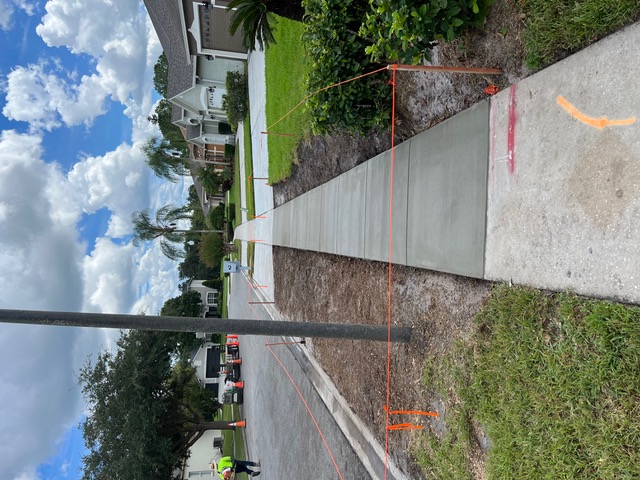
A sidewalk replacement along a residential street. Raised joints like this are a standard line on an HOA punch list.
Precision Concrete & Construction repairs sidewalks and curbs for HOA management companies and licensed community association managers in Orange, Seminole, Brevard, Volusia, Osceola, and Lake counties. A raised joint on a community walk is a trip hazard. The manager’s job is to get it on a punch list before a resident reports a fall.
Central Florida walks fail in a predictable way. Live oaks and laurel oaks send roots under the panels. Irrigation keeps the soil soft. Afternoon storms wash sand out from the edge of a slab. Most community sidewalks were poured in short panels, with a joint every few feet, so one root can lift a single square and leave a lip the next panel does not match. That lip is what catches a shoe. Mail carriers, residents walking at dusk, and anyone headed to the pool are the people who hit it.
On a walk-through, measure the lip. Do not guess from the truck. A quarter inch is already enough to trip someone who is not looking down. A half inch shows clearly in a photo if a ruler or a business card is set on the low side. Note whether the panel rocks when you step on the corner. A rocking panel is loose, and grinding a loose panel does not make it safe. Also look at the curb. A lifted walk often rolls the curb with it, and a broken curb is its own line on the estimate even when it sits at the same address.
What to send with the punch list
Mark the location so the board and the crew can find it later. The street name, the nearest house number, and which side of the street are enough. “By the oak” is not enough once the leaves drop. A phone photo of the lip, taken from the side so the height shows, is worth more than a paragraph. If the association paints the lips orange so residents can see them, say so. Those marks are a map of the list, and they wear off.
Group the joints instead of sending forty separate emails. One list, one photo per joint, and a note of the approximate height is what turns a complaint log into a scope. If a previous vendor already ground some of the lips, mark those as done so they are not priced again. If a panel is cracked through, spalled, or rocking, write that next to the height. Height alone does not pick the repair.
When the joint is ground
For a vertical lift of about 1/4 inch to 1 inch, the repair is a grind. Precision Concrete & Construction starts with a gas-powered scarifier, which cuts the high concrete down, then finishes the face with a diamond grinder so the joint is smooth underfoot. A three-chamber vacuum runs with the tools so silica dust does not settle on the walk, the grass, or the cars. Collecting that dust is an OSHA rule. It is also what keeps a grinding day from coating the community in white powder.
The finished joint should meet the next panel without a new edge. A grind that stops short, or that leaves a groove in the middle of the panel, is another trip. The crew should be able to say, before they leave that street, when residents can walk it. Grinding dust and a wet slurry are the reasons to keep people off it for that short window, not a multi-day cure.
When the slab has to come out
Grinding has a limit. Past about an inch of lift, taking the concrete down leaves a thin slab and a steep slope into the next panel. That is not a repair. The slab comes out. Roots that caused the lift are trimmed or removed so the new panel does not rise again in a season. New concrete is formed and placed to meet the walks on either side. If the grade already runs the wrong way, toward a house or into a low spot, say that on the punch list. Replacing the panel without correcting the slope puts the water back where it was.
A few items do not belong in the concrete price unless the manager asks for them. Irrigation heads broken by the saw, sod torn up along the form, and a root the landscape company is already contracted to handle should be called out so the board is not surprised on the first day. The estimate should say which joints are a grind and which panels are a replacement, with a quantity and a price for each. “Sidewalk repairs, lump sum” is hard to vote on, because a director cannot tell what was left off.
Waiting makes the list more expensive. A lip that could have been ground in the spring is often a full replacement by the time the board meets in the fall, because the root kept growing and the panel cracked. An asphalt smear over the lip looks like a fix from the street and becomes its own trip edge in the heat. Residents report the same joint again.
Send the punch list of raised joints, with photos, to Precision Concrete & Construction. Grinds and replacements go on one written estimate the manager can take to the board. Call (407) 925-7873 or email info@precisionpaintandconstruction.com. The company does this work in Orange, Seminole, Brevard, Volusia, Osceola, and Lake counties.